Global buyers need more than a long supplier list when selecting dry moly lube for demanding applications. They need evidence, consistency, and technical support. This 2026 guide examines leading suppliers through practical purchasing criteria, including molybdenum disulfide concentration, operating temperature, load capacity, application method, packaging, and batch traceability.
Tribology specialist Dr. Robert L. Fusaro offers a useful reminder: “The best lubricant is the one that meets the requirements of the application.” That principle matters here. A dry moly lube designed for threaded fasteners may not suit aerospace hinges, high-pressure bushings, or slow-moving industrial slides. Buyers should review technical data sheets, safety documentation, quality certifications, and test methods before comparing prices.
The evaluation also considers production scale, export experience, regional logistics, private-label services, and responsive engineering support. A supplier with a modern factory is not automatically the best choice. Some companies provide excellent coatings but weak documentation. Others offer attractive prices but limited testing details. Those gaps deserve attention.
Real operating conditions remain decisive. Dust, vibration, moisture, surface finish, and installation technique can change lubricant performance. Even a respected brand may fail when applied too thickly. This guide is not a permanent ranking. Markets change, formulas improve, and supply reliability can shift quickly. It is a practical starting point for global buyers who want safer comparisons and fewer costly assumptions.
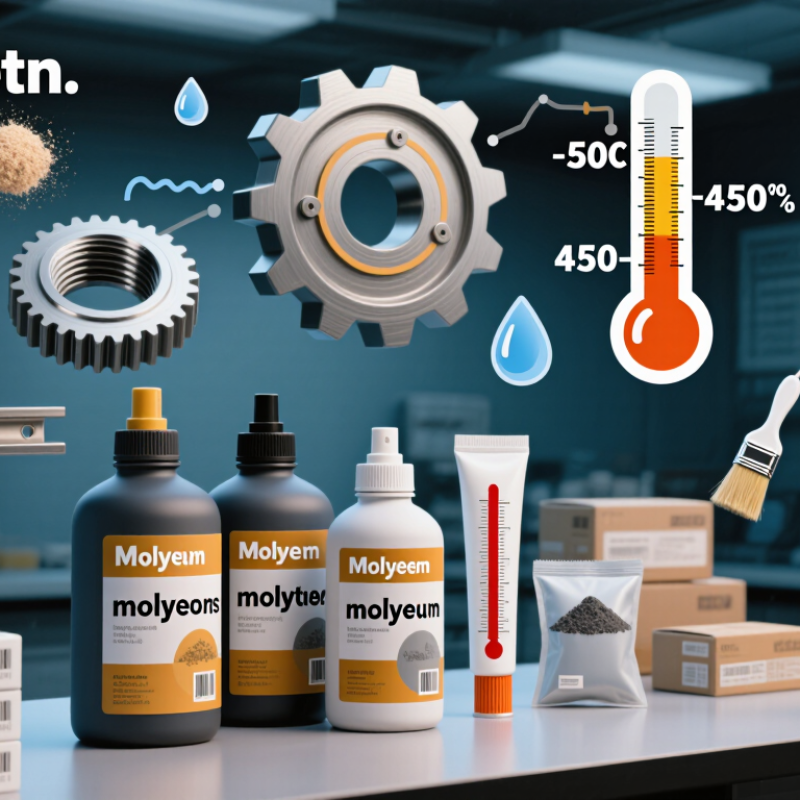
Dry molybdenum lubricant usually contains molybdenum disulfide, or MoS2. Its layered particles slide across each other under pressure. This structure reduces friction without relying on liquid oil. The film can remain useful during start-stop motion, heavy loading, and some vacuum applications. It is common on gears, hinges, threaded fasteners, bearings, aerospace mechanisms, and metal forming tools. The U.S. Geological Survey’s Mineral Commodity Summaries 2025 estimated global molybdenum mine production at about 260,000 metric tons in 2024. That figure shows a large raw-material base, but it does not guarantee lubricant quality.
The application still decides the result. A dry film may resist squeeze-out, yet moisture, oxidation, poor surface preparation, or excessive speed can shorten its life. Field inspections often find contamination under the coating. That detail is easy to miss. Buyers should request coating thickness, operating-temperature data, load-test results, and substrate compatibility. Relevant laboratory methods, including ASTM tribology testing, can support comparison. However, test results may not reproduce vibration, dust, or repeated assembly. A controlled trial remains necessary. It is not perfect, but it is honest.
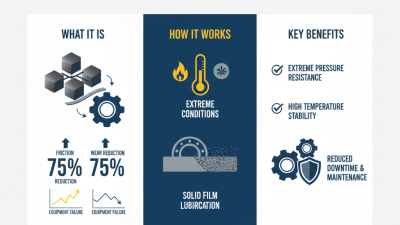
The 2026 global dry moly lube supplier market is defined by qualification, not catalogue size. Dry moly lubricants usually rely on molybdenum disulfide, or MoS₂, for low-friction performance under pressure. Grand View Research valued the global solid lubricants market at more than USD 1 billion in 2023 and expects continued growth this decade. That figure includes graphite and other materials, so it should not be treated as a pure MoS₂ market estimate.
Supply security is becoming more important. The U.S. Geological Survey’s Mineral Commodity Summaries 2025 reported approximately 260,000 metric tons of global mined molybdenum production in 2024. However, mining volume does not guarantee coating-grade powder availability. Serious suppliers must show particle-size control, purity data, batch traceability, and documented testing. Buyers should request friction, wear, adhesion, salt-spray, and temperature results for the exact formulation.
Application evidence matters more than marketing language. A supplier supporting aerospace-style fasteners, automotive parts, or industrial molds should explain surface preparation, film thickness, curing temperature, and storage life. Technical staff should also clarify whether the product suits steel, stainless steel, or coated substrates. Many supplier comparisons remain too broad. That is a weakness. Regional inventory, export documentation, safety data sheets, and realistic lead times can define the market more accurately than revenue rankings. MarketsandMarkets’ dry lubricant forecasts indicate mid-single-digit annual growth, but forecast boundaries differ between reports. Buyers should therefore compare testing depth, not only projected market size.
Selecting an international dry moly lube supplier requires more than comparing prices. MarketsandMarkets projects the global dry lubricants market to grow at roughly 6% annually through 2028, increasing pressure on suppliers to prove consistency. Ask for recent batch certificates, molybdenum disulfide purity, particle-size data, and coating-thickness tolerances. A reliable supplier should explain its testing methods clearly.
Request technical data aligned with recognized standards, including ASTM tests for adhesion, wear, corrosion, and operating temperature. Check whether the supplier tests after humidity exposure, not only under ideal laboratory conditions. That detail matters in marine containers and unheated warehouses. The World Bank’s logistics indicators also show how border delays can affect delivery reliability, so verify safety stock, packaging, export documents, and lead-time performance. Small containers should arrive sealed, labeled, and free from settled contamination.
Audit the manufacturing site when possible. Review calibration records, traceability systems, complaint handling, and corrective-action reports. A supplier with ISO 9001 certification offers useful evidence, but certification alone proves little about moly performance. Ask for samples from three production lots. One sample is not enough. I would also compare viscosity, spray pattern, and friction results in your actual application. Published data can look impressive. Field conditions are less polite. Some evaluations miss storage aging, operator technique, or surface preparation. Those gaps deserve written answers before a global purchase.
| Evaluation Dimension | Buyer Verification Criterion | Relevant Technical or Commercial Benchmark | Evidence to Request | Priority |
|---|---|---|---|---|
| Product Chemistry | Declared molybdenum disulfide (MoS₂) content | Commercial dry-film products commonly disclose MoS₂ as a percentage by mass or identify it as the principal solid lubricant. The exact level should be matched to the application rather than selected by percentage alone. | Current technical data sheet, safety data sheet, certificate of analysis, and batch composition statement | High |
| Lubrication Mechanism | Suitability for boundary and low-speed sliding conditions | MoS₂ forms a low-shear lubricating film and is widely used where liquid oils or greases may evaporate, migrate, or attract contamination. Performance depends on humidity, load, film thickness, and counter-surface material. | Application guide, friction and wear data, substrate compatibility list, and test conditions | High |
| Temperature Capability | Validated continuous and intermittent operating-temperature range | Do not rely only on a generic temperature claim. Confirm separate continuous, peak, curing, storage, and application temperatures because binder systems can limit performance before MoS₂ itself degrades. | Temperature curve, test report, curing schedule, and written confirmation for the buyer’s duty cycle | High |
| Load and Wear | Load-carrying capacity and wear resistance under defined conditions | Compare results only when the same test method, load, speed, duration, counterface, and film thickness are used. Commonly requested methods include four-ball testing and reciprocating or pin-on-disk wear testing. | Independent or laboratory test report with complete parameters and failure criteria | High |
| Corrosion Protection | Resistance to humidity, salt exposure, and galvanic conditions | A dry MoS₂ film is not automatically a corrosion coating. For outdoor, marine, or chemically exposed parts, require dedicated corrosion data and verify compatibility with steel, aluminum, stainless steel, and plated surfaces. | Humidity and salt-spray results where relevant, corrosion observations, and substrate preparation instructions | High |
| Surface Preparation | Defined cleaning, roughness, masking, and pre-treatment requirements | Adhesion and service life are strongly affected by oil removal, oxide removal, surface profile, and contamination control. A supplier should specify preparation rather than provide only a product name. | Work instruction, recommended surface roughness range, adhesion method, and approved cleaning agents | High |
| Application Process | Repeatable spray, dip, brush, or automated application process | Confirm whether the product requires mixing, dilution, agitation, multiple coats, flash-off time, or controlled curing. Wet and dry film thickness should be measurable on production parts. | Application procedure, equipment parameters, wet-film and dry-film measurement guidance, and process capability data | High |
| Curing Requirements | Compatibility with available plant temperature and cycle time | Ambient-cure and heat-cure systems serve different supply chains. Validate oven temperature uniformity, part-mass effects, cure time, and post-cure handling before approval. | Curing profile, minimum and maximum cure limits, shelf-life impact, and production trial record | High |
| Material Compatibility | Performance on the actual mating materials and finishes | Test the complete pair, such as steel-on-steel, stainless steel-on-steel, aluminum-on-steel, or coated components. A formulation that performs well on one substrate may have different adhesion or wear behavior on another. | Compatibility matrix, sample parts, adhesion results, and customer-specific validation report | High |
| Quality Management | Controlled manufacturing and batch traceability | Prefer suppliers able to provide lot identification, retained samples, change control, nonconformance handling, and a documented quality-management system such as ISO 9001 where applicable. | Quality certificate, audit questionnaire, batch certificate, change-notification policy, and complaint procedure | High |
| Regulatory Documentation | Export-ready chemical and transport documentation | Documentation should reflect the destination market and product format. Depending on formulation and shipment mode, buyers may need SDS, classification and labeling data, customs information, and region-specific chemical compliance declarations. | Current SDS, transport classification, tariff information, regulatory statement, and language-specific labels | High |
| Environmental and Workplace Safety | Control of solvent, aerosol, dust, and worker-exposure risks | Compare solvent-based, water-based, and solid or aerosol formats using the full SDS. Evaluate ventilation, flammability, personal protective equipment, waste treatment, and local workplace limits. | SDS sections 2, 8, 9, 10, 13, and 14; VOC information where applicable; safe-use instructions | High |
| Technical Support | Ability to support qualification, troubleshooting, and process transfer | A capable international supplier should provide sample evaluation, application guidance, failure analysis, and a named technical contact across time zones. | Technical-support scope, response-time commitment, trial protocol, and escalation process | Medium |
| Supply Reliability | Capacity, lead-time stability, and continuity planning | Assess normal lead time, peak-season lead time, minimum order quantity, production capacity, packaging options, safety stock, and contingency plans for raw-material interruptions. | Written quotation, capacity statement, forecast policy, continuity plan, and recent on-time-delivery data | High |
| Packaging and Shelf Life | Packaging integrity and usable storage period | Verify container size, sealing, temperature limits, freeze protection where relevant, settling or agitation requirements, and shelf life from the manufacturing date. | Packaging specification, storage instructions, shelf-life statement, and transport test information | Medium |
| Commercial Transparency | Total landed cost rather than unit price alone | Compare product price, dilution or coverage rate, freight, duties, hazardous-goods charges, application losses, curing energy, inspection, and rework costs. | Incoterms, price validity, freight assumptions, coverage estimate, payment terms, and warranty conditions | High |
| Qualification Method | Documented sample-to-production approval path | Use a staged process: document review, laboratory screening, component testing, pilot production, process audit, and controlled production release. | Qualification plan, acceptance criteria, test coupons or parts, deviation process, and final approval record | High |
Note: The benchmarks above are brand-neutral purchasing and validation criteria. Actual performance, operating limits, compliance status, price, lead time, and minimum order quantity must be confirmed in current supplier documentation and application-specific testing.
In 2026, global buyers need more than low prices from dry moly lube suppliers. They need proven production control, responsive technical support, and stable export capacity. Experienced suppliers should explain coating methods, curing conditions, shelf life, and application limits clearly. Their facilities should support consistent batch production, secure packaging, and traceable raw materials.
Dry moly lubricants may come as aerosol sprays, pastes, powders, or bonded coatings. Each type suits different surfaces and temperatures. Aerosols help with field maintenance, while bonded coatings support controlled industrial assembly. Quality checks should include friction performance, wear resistance, adhesion, moisture behavior, and temperature stability. Suppliers should provide technical data sheets, safety documents, batch records, and test reports. ISO-based quality systems can strengthen reliability, but certificates alone are not enough. A polished document cannot replace practical test evidence.
Tips: Request a sample from the exact production batch. Test it on your actual metal surfaces and load conditions. Check spray consistency, drying time, residue, and storage behavior. Ask how the supplier handles complaints and failed batches. Small details matter. Some suppliers may offer impressive specifications but limited application guidance. That weakness deserves careful review. A clear trial report often reveals more than a sales presentation.
Indicative temperature ranges commonly associated with dry molybdenum disulfide lubricant formats. Actual limits depend on binder chemistry, load, atmosphere, application method, and supplier technical data.
Coated films and powders can support higher temperatures than aerosol and paste formats, while quality evaluation typically focuses on composition consistency, adhesion, wear resistance, corrosion protection, and batch traceability.
Comparing dry moly lube suppliers in 2026 requires more than checking the lowest quoted price. An experienced buyer should request a full specification, batch size, packaging details, and delivery terms. Ask whether the price includes testing, export documents, insurance, and local duties. A cheaper drum may become expensive after freight and customs charges.
Compliance evidence should be specific and current. Request safety data sheets, certificates of analysis, traceability records, and declarations relevant to the destination market. Verify revision dates and compare product identifiers across every document. Independent laboratory testing can confirm molybdenum content, particle size, moisture, and contamination levels. Documents can look complete. Gaps still occur.
Delivery risk needs practical review. Compare normal lead time, production capacity, minimum order quantities, and backup inventory. Ask how the supplier handles port delays, damaged packaging, or a failed batch. Confirm the Incoterm and responsibility for temperature, moisture, and transit damage. A pilot order can reveal labeling or packing weaknesses before a large shipment. I would not rely on one promise. Supplier audits, sample approvals, and clear corrective-action procedures provide stronger evidence. Even careful comparisons have limits, especially when forecasts change or regional regulations are updated.