
2026 Top Hydraulic Rubber Hose Types for Global Buyers
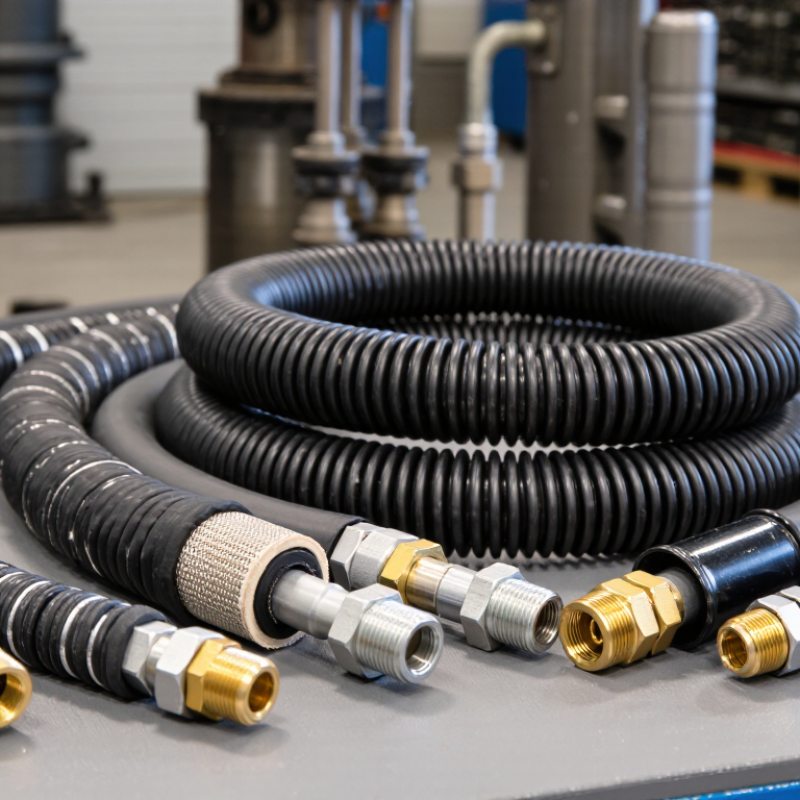
Reinforcement structures determine how hydraulic hoses handle pressure, movement, and repeated loading. In heavy-duty applications, the rubber tube carries fluid, but the reinforcement carries the force. Common structures include textile layers, wire braid, and spiral-wound wire. Each design serves a different duty.
Wire-braided hoses
Wire-braided hoses offer good flexibility for machinery with frequent bending. They suit mobile equipment, lifting systems, and compact routing spaces.
Spiral-wire hoses
Spiral-wire hoses use multiple wire layers for higher pressure and stronger impulse resistance. They are useful near pumps, excavators, presses, and other demanding circuits. However, extra strength often means a larger bend radius and a stiffer installation.
Textile reinforcement works well in lower-pressure return lines and lightweight systems. It can reduce weight, but it may not tolerate severe pressure spikes or external crushing.
Selection should consider working pressure, temperature, abrasion, vibration, and minimum bend radius. Inspectors should also check whether fittings match the hose construction. A strong hose can still fail when poorly routed.
Small details matter.
Avoid twisting during assembly. Keep the hose away from sharp edges and hot surfaces. Clamps should support the line without squeezing it.
Pressure ratings also change with temperature and service conditions, so a catalog value is not always enough. No structure is perfect.
A careful buyer should question simplified charts, review real operating data, and allow a safety margin for unexpected loads.