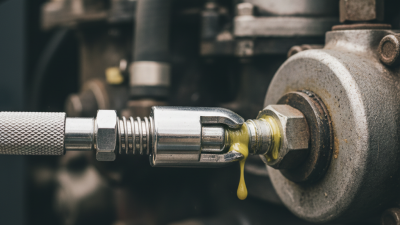
Choosing the right grease for grease gun is a practical maintenance decision, not a minor purchasing detail. The wrong product can cause noisy bearings, rising temperatures, seal damage, or premature equipment failure. A grease gun only delivers the lubricant. It cannot correct an unsuitable formulation.
Lubrication educator Jim Fitch, founder of Noria Corporation, explains, “Grease is not just oil with a thickener; it is engineered for a specific application.” That principle matters beside a real machine. A technician may see a familiar cartridge, attach it quickly, and assume compatibility. However, base oil viscosity, thickener type, operating temperature, load, speed, water exposure, and manufacturer recommendations all influence performance. Lithium grease may work well in one bearing, while calcium sulfonate complex grease performs better under heavy loads or wet conditions. They are not automatically interchangeable.
Small details matter.
A clean coupler, correct purge interval, and properly stored cartridge can prevent contamination. Yet even experienced teams make mistakes. They may select grease by color, trust an old label, or overfill a sealed bearing. Color is not a performance standard. More grease is not always safer. The consequences often appear later, as heat near a bearing housing or grease leaking across a dusty shaft.
This guide examines why the right grease for grease gun protects equipment, improves reliability, and supports safer maintenance decisions. It also considers compatibility, application methods, and common selection errors. No checklist replaces the equipment manual or direct inspection. Still, a disciplined choice is far better than guessing.
Why Use the Right Grease for Grease Gun?
Grease-gun lubrication depends heavily on NLGI consistency grade. The NLGI scale runs from 000 to 6, based on worked penetration at 25°C under ASTM D217 testing. NLGI data lists grade 000 at approximately 445–475 penetration units, while grade 6 measures only 85–115. Lower numbers flow more easily. Higher numbers resist movement.
Grade 000 resembles thick oil and suits enclosed gears or centralized systems. Grades 00 and 0 can move through narrow lines, especially in cooler conditions. Grade 1 often supports mobile equipment. Grade 2 remains the common choice for many rolling bearings. Grade 3 may help where leakage or higher temperature demands greater body. Grades 4 to 6 are much stiffer and need careful application planning.
A grease gun must match the grease, temperature, seals, and delivery line. I have seen a pump struggle when grade 2 replaced grade 00 in a long pipe. The grease looked similar. The pressure did not. A recent NLGI Lubricating Grease Guide also stresses that consistency alone cannot define performance; thickener type, base oil viscosity, additives, and operating temperature matter. ASTM D4950 further evaluates automotive grease performance beyond consistency. The imperfect part is field judgment. A higher NLGI grade may reduce leakage, but it can also restrict flow and starve a bearing. Always verify the equipment manual, purge compatibility, and actual operating temperature.

Choosing grease for a grease gun starts with consistency, not color or appearance. NLGI 2 grease has a worked penetration range of 265–295 units. These units represent tenths of a millimeter, measured under a recognized laboratory test. The range describes how firm the grease is after working.
NLGI 2 is common for many bearings, pins, bushings, and general-purpose lubrication points. It usually balances flow through the gun with resistance to leakage. However, the correct grade still depends on the equipment manual, fitting design, temperature, load, and grease path length. A long hose or narrow fitting can make delivery harder. Cold weather makes the problem more obvious.
In practical maintenance, I check whether the lever moves smoothly and whether grease reaches the fitting without excessive force. I also inspect the old grease for separation, hard lumps, or contamination. Penetration alone does not reveal the grease’s base oil viscosity or thickener compatibility. I once assumed a stiff pump meant a blocked fitting, but low temperature was the real cause. That mistake changed my inspection routine.
Keep the cartridge and tools clean. Avoid mixing greases unless compatibility has been confirmed by technical data. When delivery feels abnormal, measure the pressure, inspect the fitting, and question the selected consistency. NLGI 2 may be suitable, but it is not automatically suitable everywhere.
Why Use the Right Grease for Grease Gun?
Match Base-Oil Viscosity to Speed and Load: ISO VG 46–680
A grease gun delivers lubricant, but it cannot correct a poor viscosity choice. Base-oil viscosity controls film strength between moving metal surfaces. ISO VG 46 suits fast-moving bearings with light loads and limited heat. The thinner oil flows quickly and reduces churning resistance. It may fail under heavy pressure, however.
Slower equipment needs a different approach. ISO VG 150 or 220 can support moderate loads and common industrial speeds. For heavily loaded gears, pins, or slow oscillating joints, ISO VG 320–680 creates a stronger protective film. These grades resist squeezing from contact zones. Cold conditions can make them difficult to pump. That detail is easy to overlook.
NLGI grade is not base-oil viscosity. A grease can be NLGI 2 with several different base-oil viscosities. Check both values before loading a grease gun. I have seen machines run hotter after switching to an overly thick grease. The grease looked suitable, yet the motor worked harder. Not every problem needs a thicker lubricant.
Observe bearing temperature, noise, leakage, and grease consumption after application. Compare these signs with the equipment manual and operating conditions. High speed, low load, and warm housing often favor ISO VG 46–100. Low speed, shock load, and high contact pressure may require ISO VG 460–680. Real service conditions still matter more than a simple chart.
| ISO VG Grade |
Nominal Base-Oil Viscosity at 40°C |
Relative Speed Suitability |
Load and Shock Capability |
Typical Grease-Gun Applications |
Selection Considerations |
|---|---|---|---|---|---|
| 46 | 46 cSt ISO range: 41.4–50.6 cSt |
Very high | Light to moderate | High-speed electric-motor bearings, small high-speed bearings, and lightly loaded precision points. | Use only when the bearing design, temperature, seal arrangement, and manufacturer guidance support a low-viscosity base oil. |
| 68 | 68 cSt ISO range: 61.2–74.8 cSt |
High | Light to moderate | Fast-running bearings, moderate-speed motors, fans, and lightly loaded industrial lubrication points. | Provides better film strength than ISO VG 46 while maintaining relatively low churning resistance. |
| 100 | 100 cSt ISO range: 90–110 cSt |
Moderate to high | Moderate | General-purpose rolling-element bearings, moderate-speed conveyor bearings, and electric motors under normal loads. | A common balanced choice where both speed and load are moderate and operating temperatures are stable. |
| 150 | 150 cSt ISO range: 135–165 cSt |
Moderate | Moderate to heavy | Medium-speed bearings, industrial rollers, machine-tool components, and moderately loaded pivot points. | Offers increased separation between metal surfaces but may raise friction and operating temperature at high speeds. |
| 220 | 220 cSt ISO range: 198–242 cSt |
Low to moderate | Heavy | Heavily loaded bearings, conveyors, general industrial machinery, and slow-to-medium speed bushings. | Suitable when load and shock protection are more important than minimum churning and drag losses. |
| 320 | 320 cSt ISO range: 288–352 cSt |
Low | Very heavy | Slow, heavily loaded bearings, large pins, bushings, rollers, and equipment exposed to vibration. | Use for high-load or low-speed service; confirm that the grease can still be pumped through the selected grease gun and fittings. |
| 460 | 460 cSt ISO range: 414–506 cSt |
Very low | Extremely heavy | Large, slow-moving bearings, heavily loaded pins, construction equipment joints, and severe shock-load points. | High resistance to load-induced film breakdown, but higher grease resistance and reduced pumpability can occur in cold conditions. |
| 680 | 680 cSt ISO range: 612–748 cSt |
Extremely low | Extreme load and shock | Very slow, heavily loaded open gears, large plain bearings, heavy pins, and severe-duty industrial joints. | Reserve for slow and highly loaded applications; verify pumpability, temperature limits, sealing, and compatibility before use. |
Choosing grease for a grease gun requires more than matching the cartridge size. Temperature and water exposure can change performance quickly. ASTM D4950 classifies automotive service greases, while ISO 6743-9 describes grease performance categories for operating conditions. These standards help technicians compare products using consistent technical language.
The NLGI Lubricating Grease Guide lists Grade 2 grease with a worked penetration of 265–295, measured in 0.1 millimeters. This consistency usually suits many general grease-gun applications. However, it does not prove high-temperature stability. Under ASTM D4950, GC-class grease requires a dropping point of at least 220°C. That figure is only a screening value. It is not a safe continuous operating temperature.
Water needs a separate check. ASTM D4950 includes water-related performance requirements, but ASTM D1264 measures water washout directly. The test reports the percentage of grease removed under controlled water exposure, often at 79°C. Lower loss generally suggests better resistance, though field results can differ. ISO 6743-9 should then be checked for the grease’s temperature and water-resistance classifications.
I once treated dropping point as the operating limit. That was a poor assumption. A bearing near a washdown area needs more evidence: worked penetration, water washout, corrosion protection, and actual temperature history. Review the product’s test report against ASTM D4950, ASTM D1264, ISO 6743-9, and the NLGI consistency table before loading the grease gun.
Grease selection should match the application’s temperature and water exposure. ASTM D4950 classifies automotive service greases by performance categories such as GC, LB, and GC-LB, while ISO 6743-9 uses a coded system that identifies grease properties including operating temperature and water resistance.
The chart shows the two key selection checks addressed by both standards. These are classification requirements, not product-performance scores; the actual grease must still be verified against the equipment manufacturer’s operating limits.
A grease gun delivers more than lubrication. It also introduces a new thickener, base oil, and additive package into the bearing. If the new grease is incompatible, the mixture may soften, harden, separate, or lose its protective film. I once assumed that matching the grease color was enough. It was not. Color identifies appearance, not chemistry.
Check the equipment manual before loading the gun. Confirm the required consistency grade, operating temperature, water resistance, and load performance. OEM limits also matter.
Excessive pressure can damage seals, while too much grease can raise bearing temperature. A small bearing may need only a few measured shots, not a full lever stroke.
Count the strokes and record the date.
Never mix greases casually. Thickener families can react unpredictably, even when both products look suitable.
If the previous grease is unknown, remove as much of it as practical and purge slowly through the relief path.
Watch for changes in texture, color, or temperature. Stop if the purge grease becomes lumpy or leaks past the seal.
Compatibility charts provide useful guidance, but they are not a substitute for testing under real conditions.
A clean sample and an OEM recommendation offer stronger evidence. Mistakes happen. The important part is noticing them early and questioning familiar habits.