Choosing the right grease pump in 2026 is no longer a simple catalog decision. It affects bearing life, maintenance time, lubricant waste, and equipment reliability. A pump that feels powerful may still deliver the wrong volume or pressure.
Grand View Research’s Industrial Lubricants Market report and MarketsandMarkets’ Lubrication Systems Market report both identify automation, predictive maintenance, and industrial efficiency as major growth drivers. However, their market estimates differ. That gap deserves attention. Report definitions are not always consistent, especially when grease pumps, centralized systems, and accessories are counted together.
The U.S. Department of Energy’s Operations & Maintenance Best Practices guide associates predictive maintenance programs with energy savings of about 8% to 12% in documented applications. Better lubrication can support those results, but the pump must match the machine. Check grease consistency, delivery rate, operating pressure, hose length, temperature, and power source. A small workshop may need a manual or battery-powered grease pump. A production line may require automatic metering and monitoring.
Jim Fitch, founder of Noria Corporation, expresses the core principle clearly: “The right lubricant, in the right amount, at the right time.” That rule sounds basic. It is often missed.
A reliable grease pump should deliver measured lubrication, not guesswork. Look for verified output data, compatible seals, accessible spare parts, and clear maintenance instructions. The cheapest option can become expensive beside a seized bearing, a stopped conveyor, or an avoidable service call. Perfect selection is difficult. Careful verification is still better than confident assumption.
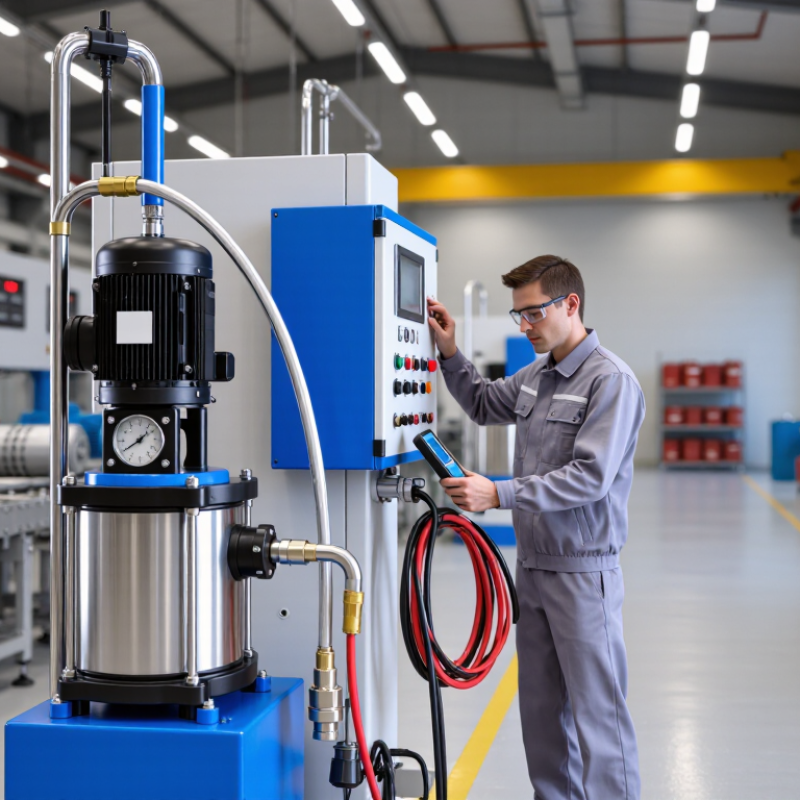
Choosing a grease pump in 2026 starts with the grease, not the pump catalog. NLGI grades describe consistency, measured by worked penetration under ASTM D217. Grade 000 measures 445–475, while Grade 2 measures 265–295, in units of 0.1 millimeter, according to NLGI’s published classification data. Lower grades flow more easily through long, narrow lines. Higher grades usually resist leakage better.
ASTM D4950 adds performance requirements for automotive service grease. Its categories include chassis grades LA and LB, plus wheel-bearing grades GA, GB, and GC. A pump selected for Grade 2 grease may still fail when the grease has poor low-temperature flow. That detail is easy to miss. For centralized systems, check the manufacturer’s actual pressure, hose length, outlet diameter, and operating temperature. Do not rely on NLGI grade alone.
In field maintenance, I would normally compare the grease’s worked penetration with the pump’s feed capability. A Grade 00 product can move through restrictive tubing more easily than Grade 2. However, excessive pressure can indicate blocked lines, hardened grease, or incorrect fittings. The NLGI 2023 Grease Production Survey also shows that automotive and industrial grease demand remains substantial, but market volume does not prove suitability for one machine. I have seen “universal” choices perform poorly in cold starts. ASTM D4950 compliance helps, yet application testing remains necessary. A small temperature trial can reveal more than a confident label.
| NLGI Grade | Worked Penetration at 25 °C (ASTM D217, 0.1 mm) |
Typical Consistency | Typical Pumpability and Equipment Fit | Common Application Examples | Recommended Pump Characteristics | Important Selection Notes |
|---|---|---|---|---|---|---|
| 000 | 445–475 | Very fluid; semi-fluid grease | Usually the easiest grease grade to move through long, narrow lines and automatic lubrication systems. | Enclosed gears, centralized systems, and applications requiring a fluid grease. | Low-pressure metering pump, small-diameter tubing, and metering devices rated for semi-fluid grease. | Check leakage control and reservoir design. A pump must be compatible with the lubricant’s operating temperature and thickener system. |
| 00 | 400–430 | Fluid; semi-fluid grease | Generally suitable for centralized lubrication when the system is designed for semi-fluid products. | Enclosed gear drives, chassis systems, and low-temperature centralized lubrication. | Positive-displacement pump with a suitable follower plate or reservoir arrangement; use appropriately sized lines. | Verify the manufacturer’s minimum pump temperature and the product’s flow behavior before selecting hose and fittings. |
| 0 | 355–385 | Soft grease | Good pumpability, but more resistance than NLGI 00 in long lines or at low temperatures. | Centralized systems, bearings, and moderate-load components. | Positive-displacement pump with moderate pressure capability and a properly sized suction inlet. | Useful where a softer grease is needed for delivery, but confirm that the bearing or gearbox does not require a stiffer grade. |
| 1 | 310–340 | Soft to moderately soft grease | Normally pumpable in centralized systems with correctly sized lines and fittings. | Electric-motor bearings, chassis points, and general industrial lubrication. | Electric, pneumatic, or manual positive-displacement pump; include a pressure-relief device where required. | A common choice for automatic lubrication in cooler conditions, but temperature and line length strongly affect delivery pressure. |
| 2 | 265–295 | Moderate consistency; common general-purpose grade | Usually pumpable, but requires more pressure than NLGI 1, especially through long or cold lines. | Rolling-element bearings, plain bearings, electric motors, pumps, and general machinery. | Heavy-duty manual lever pump, pneumatic pump, battery-powered pump, or electric pump with suitable pressure capacity. | NLGI 2 is widely used, but “multipurpose” does not guarantee compatibility with every thickener, seal, load, or temperature range. |
| 3 | 220–250 | Firm grease | More difficult to draw and dispense, particularly in cold weather or through restrictive fittings. | High-temperature bearing applications where reduced migration is desirable. | High-pressure positive-displacement pump with a large, short suction path and suitably sized delivery lines. | Use only when the equipment specification permits NLGI 3. Confirm that the pump follower plate and inlet can prevent air pockets. |
| 4–6 | 175–205, 130–160, and 85–115 respectively | Very firm to extremely hard | Not normally selected for standard centralized grease pumps; delivery may require special handling. | Specialized applications where low migration or high structural stability is required. | Specialized high-force equipment, heated reservoirs, or purpose-designed dispensing systems may be necessary. | Do not choose these grades solely for higher load or temperature claims. Always follow the machinery manufacturer’s lubrication specification. |
| ASTM D4950 Classification | Service Category | Primary Service Intent | Performance Areas Evaluated | Grease-Pump Selection Implication | Key Caution |
|---|---|---|---|---|---|
| LA | Light-duty chassis service | Lubrication of chassis components under light-duty automotive service conditions. | Chassis-service performance requirements, including protection against wear, corrosion, and environmental effects specified by the standard. | A standard manual or low-to-moderate pressure pneumatic grease gun is generally suitable when the grease is within the pump’s approved consistency range. | Do not use the LA designation as a substitute for the equipment manufacturer’s service interval or lubricant recommendation. |
| LB | High-load chassis service | More severe chassis service than LA, including higher loads and demanding operating conditions. | More demanding chassis-service performance requirements, including load-carrying, wear, water, corrosion, and mechanical-stability characteristics specified by the standard. | Use a pump capable of maintaining the required dispensing pressure under the selected NLGI grade and ambient temperature. | ASTM D4950 performance classification does not determine pump pressure, hose size, or NLGI grade by itself. |
| GA | Light-duty wheel-bearing service | Wheel-bearing lubrication for light-duty service conditions. | Wheel-bearing performance requirements established by ASTM D4950 for the applicable service category. | Select a clean, dedicated dispensing system where contamination control is important; match the pump to the grease’s NLGI grade. | Wheel-bearing service may require a different grease than chassis service, even when both products appear similar. |
| GB | Moderate-duty wheel-bearing service | Wheel-bearing lubrication for moderate-duty automotive service. | Requirements addressing wheel-bearing durability and protection under the conditions defined by ASTM D4950. | A manual, battery-powered, pneumatic, or electric pump can be used if its pressure and delivery rate suit the grease and the lubrication point. | Confirm operating temperature, bearing speed, seal compatibility, and relubrication quantity separately. |
| GC | Severe-duty wheel-bearing service | Wheel-bearing lubrication for severe automotive service conditions, including demanding temperature and load environments. | More stringent wheel-bearing performance requirements specified by ASTM D4950, including relevant high-temperature, load, water, corrosion, and mechanical-stability properties. | Choose a robust positive-displacement pump with suitable pressure capacity, reliable seals, and a follower system that minimizes air entrainment. | GC is a performance category, not an indication that every GC grease is interchangeable with every other grease. |
| GC-LB | Combined wheel-bearing and chassis service | Grease meeting the combined requirements for severe-duty wheel-bearing service and high-load chassis service. | Applicable GC and LB performance requirements specified by ASTM D4950. | Useful for fleets that want one approved grease for both service points, provided the NLGI grade and dispensing equipment are appropriate. | Confirm the exact product approval, NLGI grade, thickener compatibility, and equipment specification before consolidation. |